
Insights
Insights from the lab.
Dermatopathology education, case insights, and diagnostic updates from Stratum Dx — what happens in the lab, how diagnoses are made, and how pathology supports care.
April 9, 2026
Getting DIF Right: What Referring Providers Need to Know Before the Biopsy
Direct immunofluorescence (DIF) studies are among the most technique-sensitive tests in dermatopathology. When everything goes right, they’re extraordinarily valuable —…
April 9, 2026
Narrowly Free Doesn’t Mean Worry-Free: Why Re-Excision Still Matters

You got the call. Your biopsy came back, and the skin cancer doesn’t appear to reach the edge of the removed tissue. Your report says something like closely approaches margin…
April 9, 2026
What Does My Pathology Report Actually Mean?
If you’ve ever received a pathology report and felt like you were reading a foreign language — you’re not alone. Terms like atypical basaloid neoplasm or psoriasiform…
April 9, 2026
SOX-10 vs. MART-1/Melan-A: Choosing the Right Melanocytic IHC Stain
When it comes to evaluating skin specimens, immunohistochemical (IHC) stains have transformed the way dermatopathologists identify and characterize melanocytic lesions. Two of…
February 10, 2026
What is the significance of “follicular involvement” in a biopsy pathology report?
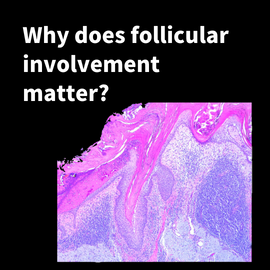
One of the questions we get from some of the providers that send us biopsies is “Why, when we make a diagnosis of actinic keratosis, squamous cell carcinoma or Bowen’s disease…
February 10, 2026
What do we do if margins were free or closely approaching the inked margins?

If I’m doing a shave or a punch of a spot I’m concerned about–maybe squamous cell carcinoma or a basal cell carcinoma–it’s easy to know if the margins are positive you have to…